Goal 6: Ensuring access to water and sanitation for all
Sustainable Development Goal 6 (SDG 6 or Global Goal 6) is one of the 17 Sustainable Development Goals set by the United Nations in 2015 and concerns "clean water and sanitation for all". According to the United Nations, the aim is: "To ensure the availability and sustainable management of water and sanitation for all." The goal has eight targets to be achieved by 2030. Progress toward the targets will be measured using eleven indicators.
Access to safe water, sanitation and hygiene is the most basic human need for health and well-being. Demand for water is increasing due to rapid population growth, urbanization and increasing water needs from the agriculture, industry and energy sectors.
Demand for water has outpaced the rate of population growth. Global water scarcity has been at 18% since 2015; one in ten people live under high or critical water scarcity, and in many regions this rate exceeds 75%. With the increase in global temperatures as a result of climate change, water scarcity is also expected to increase.
Investments in infrastructure and sanitation facilities; the protection and improvement of water-related ecosystems; and hygiene education are among the necessary steps to ensure universal access to safe and affordable drinking water for all by 2030, and increasing water use efficiency is key to reducing water scarcity.
At the current rate, the world will not achieve sustainable water management until at least 2049, and achieving the goals of universal provision of basic water, sanitation and hygiene (WASH) services in schools by 2030 will require doubling the current rate of progress.
Why?
Access to water, sanitation and hygiene is a human right. Key strategies to get back on track include increasing investment and capacity building across the sector, promoting innovation and evidence-based action, enhancing cross-sector coordination and collaboration among all stakeholders, and adopting a more integrated and holistic approach to water management.
Water is vital not only for health, but also for poverty reduction, food security, peace and human rights, ecosystems and education. However, countries face increasing challenges related to water scarcity, water pollution, degraded aquatic ecosystems, and cooperation on transboundary watersheds.
Subheadings of Goal 6
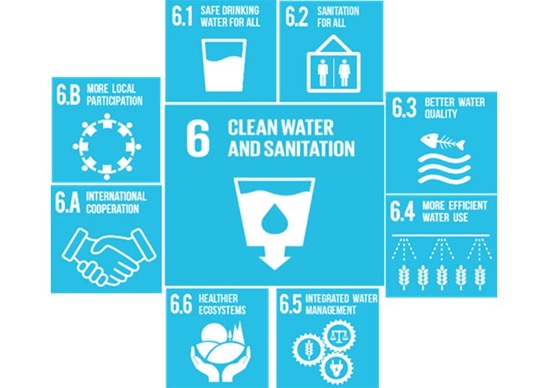
6.1 To ensure universal and equitable access to safe and affordable drinking water for all by 2030.
6.2 To ensure adequate and equitable access to sanitation and hygiene for all by 2030 and to end defecation in public areas; paying special attention to the needs of women, girls and vulnerable groups.
6.3 To improve water quality by 2030 by reducing pollution, eliminating wastewater spillage and minimizing the release of hazardous chemicals and substances, halving the rate of untreated wastewater, and significantly increasing recycling and safe reuse globally. 6.4 By 2030, to significantly increase water use efficiency across all sectors and to ensure the sustainable extraction and supply of freshwater to combat water scarcity and significantly reduce the number of people suffering from water scarcity.
6.5 By 2030, to implement integrated water resources management at all levels, including cross-border cooperation where appropriate.
6.6 By 2020, to protect and improve water-related ecosystems, including mountains, forests, wetlands, rivers, groundwater resources and lakes.
6.A By 2030, to expand international cooperation and capacity-building support to developing countries in water and sanitation-related activities and programmes, including water harvesting, desalination, water efficiency, wastewater treatment, recycling and reuse technologies.
6.B To support and strengthen the participation of local communities in improving water and sanitation management.
We use cookies to offer you the best experience and to improve the performance of our website. You can customize your preferences if you wish. For more details, please see our Cookie Policy.
Cookies are small data files stored on your device when you visit a website. They help websites remember your actions and preferences over time.
IWAFA uses cookies for the following purposes:
Essential Cookies
These are necessary for the website to function and cannot be switched off. They are usually set in response to actions made by you such as logging in or filling out forms.
Performance & Analytics Cookies
These help us understand how visitors interact with our site so we can improve the user experience. Data is collected anonymously.
Functionality Cookies
These remember choices you make, such as your language or region, and provide enhanced, personalized features.
Targeting & Advertising Cookies
These cookies track your browsing habits to deliver content and ads that are more relevant to you.
We may also allow third-party services like Google Analytics, Facebook Pixel, or other tools to set cookies on your device.
You have full control over which types of cookies we use (except for essential cookies). You can update your preferences at any time via our Cookie Settings panel or through your browser settings.